(2025 Practical Guide for Importers)
Selling electric wheelchairs globally? Missing one rule can cost you delays, fines, or lost shipments. Here’s how to navigate key markets—no jargon, just actionable steps.
1. USA: FDA & Air Travel Rules
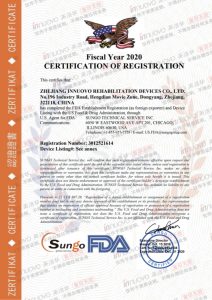
Critical Requirements:
· FDA 510(k) Approval:
· Electric wheelchairs are Class II medical devices. You must file a 510(k) application to prove safety and equivalence to existing U.S. models. Tip: Start early—approval takes 30–90 days.
· Battery Limits:
· Lithium batteries ≤300Wh allowed on flights. For dual batteries, each is ≤160Wh. Spares must be in carry-on bags.
· Labeling:
· Labels must state: “Caution: Federal law restricts sale to licensed practitioners.”.
· Packaging:
· Use 7-layer boxes + double plastic wrap to prevent damage (30% of returns are transit-related).
Please consult IYASOCARE for FDA wheelchair models.
2. Europe: CE Mark & Local Compliance
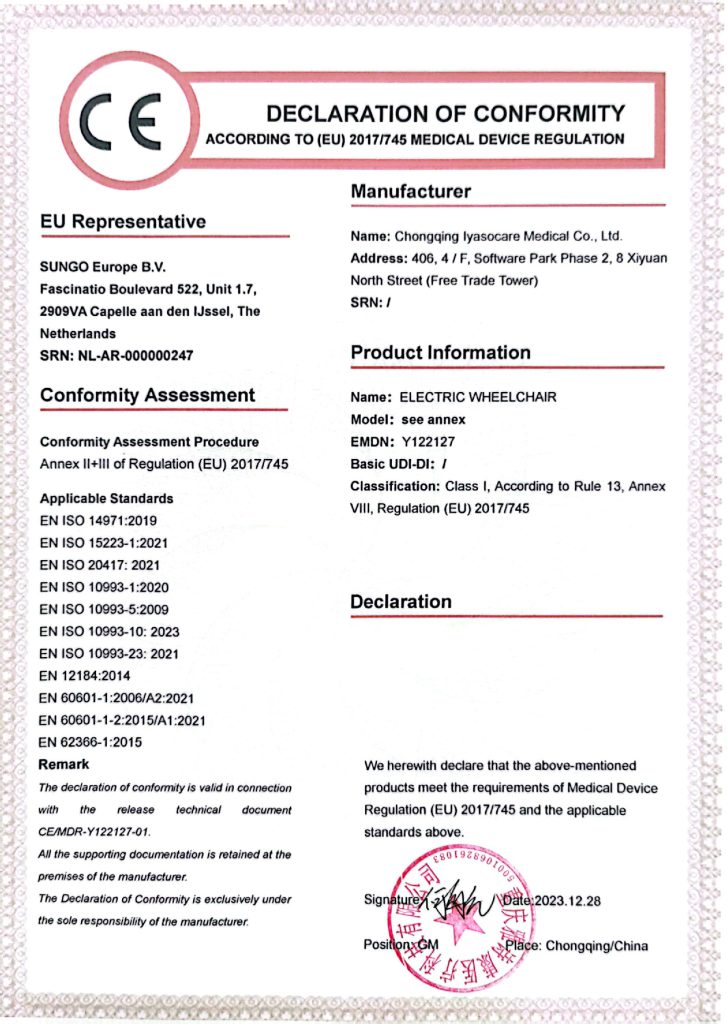
Key Steps:
· CE Self-Declaration:
· Electric wheelchairs are Class I devices. Self-declare compliance with EN 12184 standards (tests for speed ≤15 km/h, stability, battery safety).
· Language Rules:
· Manuals and labels must be in the local language (e.g., German for Germany, French for France).
· Air Travel:
· Airlines like Lufthansa allow one spare battery (≤300Wh) in carry-ons only. UN38.3 test reports are mandatory.
Please consult IYASOCARE for CE wheelchair models.
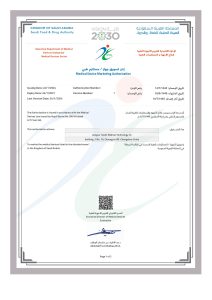
3. Middle East: Pre-Approval & Airline Coordination
Must-Do’s:
· Country Certificates:
· Saudi Arabia: SASO Certificate .
· UAE: ECAS Certificate .
· Airline Notice:
· Notify carriers (e.g., Emirates, Etihad) 48 hours pre-flight for wheelchair assistance.
· Bilingual Labels:
· Shipping documents and labels require English + Arabic.
· Battery Safety:
· Only dry-cell batteries permitted. The charge must last 1.5x the flight duration.
Please consult IYASOCARE for SFDA wheelchair models.
4. Global Shipping & Packaging
Universal Tips:
· Freight Forwarder Check:
· Ask: “Do you handle medical devices daily?” Ensure they manage UN38.3 checks and battery protocols.
· Packaging Standards:
· 7-layer hardboard boxes + double plastic wrap (blocks moisture/dust).
· Wooden crates for high-value samples (+$20 cost, prevents dents).
· Shipping Modes:
· Air: 5–7 days, ideal for samples. Max weight per box: ≤63 kg.
· Sea: 30–45 days, cheaper for bulk. Use vented containers to prevent battery corrosion.
5. Costly Mistakes to Avoid
· Late Airline Notice (Middle East): Miss 48-hour window = denied boarding.
· Missing UN38.3/MSDS Docs: Lithium batteries without UN38.3 = shipment seized.
· Weak Packaging: Flimsy boxes cause 30% damage returns. Invest in double-layer protection.
Pre-Shipment Checklist
1. USA: FDA 510(k) filed? Battery ≤300Wh? English labels?
2. Europe: CE self-declaration signed? EN 12184 tests done? Local language manual?
3. Middle East: SASO/ECAS certificate? Airline notified? Arabic labels?
4. All: UN38.3 + MSDS docs packed? 7-layer boxes used?
5. Test One Unit: Ship a sample first—check quality, docs, and transit time!
Why This Matters in 2025
· USA: Paperwork is king (FDA 510k).
· Europe: Self-checks rule (CE mark).
· Middle East: Pre-approval is non-negotiable (SASO/ECAS).
· Pro Tip: Partner with brands like IYASOCARE (pre-packs UN38.3/docs) to cut compliance time by 50% .
Key Takeaways
· USA: Prioritize FDA 510(k) paperwork (30-90 days).
· Europe: CE self-declaration requires EN 12184 compliance.
· Middle East: SASO/ECAS certificates and 48-hour airline notice are critical.
· Pro Tip: Partner with suppliers who pre-pack compliance docs (e.g., UN38.3) to save time.
Resources:
· FAA Battery Rules: http://www.faa.gov/hazmat/packsafe
· EU Standard EN 12184: ec. europa.eu/growth/tools-databases